How Often Should You Replace Water Filters?
How often should you replace water filters? The correct replacement schedule depends on the filter type, water quality, household water use, cartridge capacity, and manufacturer’s instructions. Some filters need replacement every two months, while certain reverse-osmosis membranes may last several years.
Do not rely only on taste, smell, or appearance to decide when a filter needs changing. Many contaminants cannot be detected without proper water testing.
Quick Answer
Always replace a water filter according to the manufacturer’s recommended number of months or rated gallon capacity—whichever limit you reach first.
Common estimates include:
- Pitcher filters: approximately every 1–3 months
- Faucet-mounted filters: approximately every 2–4 months
- Refrigerator filters: often every 6 months
- Under-sink cartridges: approximately every 6–12 months
- Countertop filters: approximately every 3–12 months
- Reverse-osmosis prefilters and postfilters: approximately every 6–12 months
- Reverse-osmosis membranes: approximately every 1–5 years
- Whole-house cartridges: approximately every 3–12 months
These are only general estimates. Follow the instructions supplied with your exact system.
Affiliate Disclosure: This page contains affiliate links. If you purchase through these links, I may earn a small commission at no extra cost to you. As an Amazon Associate, I earn from qualifying purchases. This helps support Water Purifiers World and allows me to keep providing free guides to cleaner, safer water for homes and businesses. I only recommend products I personally believe in and would use myself. Thank you for your support! Read our full affiliate disclosure.
Why Water Filters Need Regular Replacement
Water-filter cartridges have a limited service life. As water passes through a filter, sediment, chemicals, minerals, and other substances may collect in or on the filtration media.
Eventually, a filter may:
- Reach its rated contaminant-reduction capacity
- Become clogged with sediment
- Produce a slower flow rate
- Stop reducing contaminants effectively
- Develop unpleasant tastes or odors
- Allow microorganisms to grow when improperly maintained
A filter that still produces clear water is not necessarily working properly. Lead, PFAS, nitrates, arsenic, and many other substances cannot be identified by looking at, smelling, or tasting the water.
The CDC recommends changing water filters according to the manufacturer’s instructions and properly maintaining the complete filtration system.
Follow the Months or Gallons Rule
Manufacturers commonly provide filter life in one or both of the following ways:
- A particular number of months
- A rated number of gallons
For example, a cartridge might be advertised for six months or 300 gallons. If your household uses 300 gallons in four months, replace it at four months instead of waiting for the full six months.
The replacement period is generally an estimate based on expected water conditions and household use. A larger family may reach the cartridge’s gallon capacity much faster than one person living alone.
NSF explains that filter service cycles vary by product and may be based on gallons, months, or both. Replacing the cartridge as directed helps the system continue reducing the contaminants covered by its verified claims.
Typical Water-Filter Replacement Schedules
The following time ranges are general guidelines—not universal replacement instructions.
| Filter type | General replacement estimate |
|---|---|
| Water-filter pitcher | 1–3 months |
| Faucet-mounted filter | 2–4 months |
| Refrigerator water filter | About 6 months |
| Countertop filter | 3–12 months |
| Under-sink filter | 6–12 months |
| RO sediment prefilter | 6–12 months |
| RO carbon prefilter | 6–12 months |
| RO postfilter | 6–12 months |
| RO membrane | 1–5 years |
| Whole-house sediment cartridge | 3–6 months |
| Whole-house carbon cartridge | 6–12 months |
Actual replacement schedules vary considerably. Check the product manual or contact the manufacturer using the exact model number.
Water-Filter Pitchers
Water-filter pitchers contain relatively small cartridges. Because of their limited size, they may require more frequent replacement than larger countertop or under-sink filters.
Depending on the product and household use, a pitcher cartridge may last approximately one to three months.
Replace it sooner if:
- It reaches its gallon capacity
- Water begins filtering unusually slowly
- The manufacturer’s indicator tells you to replace it
- The cartridge has remained unused longer than allowed
- The taste or odor changes
Wash and maintain the pitcher according to its instructions. Replacing the cartridge does not eliminate the need to clean the reservoir and lid.
Compare replacement pitcher filters on Amazon →
Faucet-Mounted Water Filters
Faucet-mounted filters commonly require replacement every two to four months, although the correct interval depends on the model and the amount of filtered water used.
Some models have an electronic indicator that estimates remaining filter life. Remember that an indicator may measure time, usage, or both. It does not necessarily test the filtered water or measure contaminant levels.
If the filter reaches its rated capacity before the indicator’s estimated date, replace it according to the manufacturer’s directions.
Compare replacement faucet filters on Amazon →
Refrigerator Water Filters
Many refrigerator manufacturers recommend replacing the water filter approximately every six months. See our guide to refrigerator water filters for help choosing a replacement. However, households using large amounts of water and ice may reach the filter’s capacity sooner.
A refrigerator indicator light is a useful reminder, but it may be based primarily on time rather than actual water quality.
Check the appliance manual for:
- The correct replacement cartridge
- The rated filter capacity
- Replacement instructions
- Required flushing after installation
- Procedures for resetting the indicator light
Use a replacement cartridge designed for the exact refrigerator model. A cartridge that fits physically may not carry the same certifications or contaminant-reduction claims as the original.
Find replacement refrigerator water filters on Amazon →
Under-Sink Water Filters
Many under-sink cartridges last approximately six to twelve months. Larger cartridges may treat more water, but filter life still depends on capacity, water quality, flow rate, and household use.
Multi-stage systems may have separate replacement schedules for each cartridge. For example, the sediment prefilter may require more frequent replacement than a larger carbon filter.
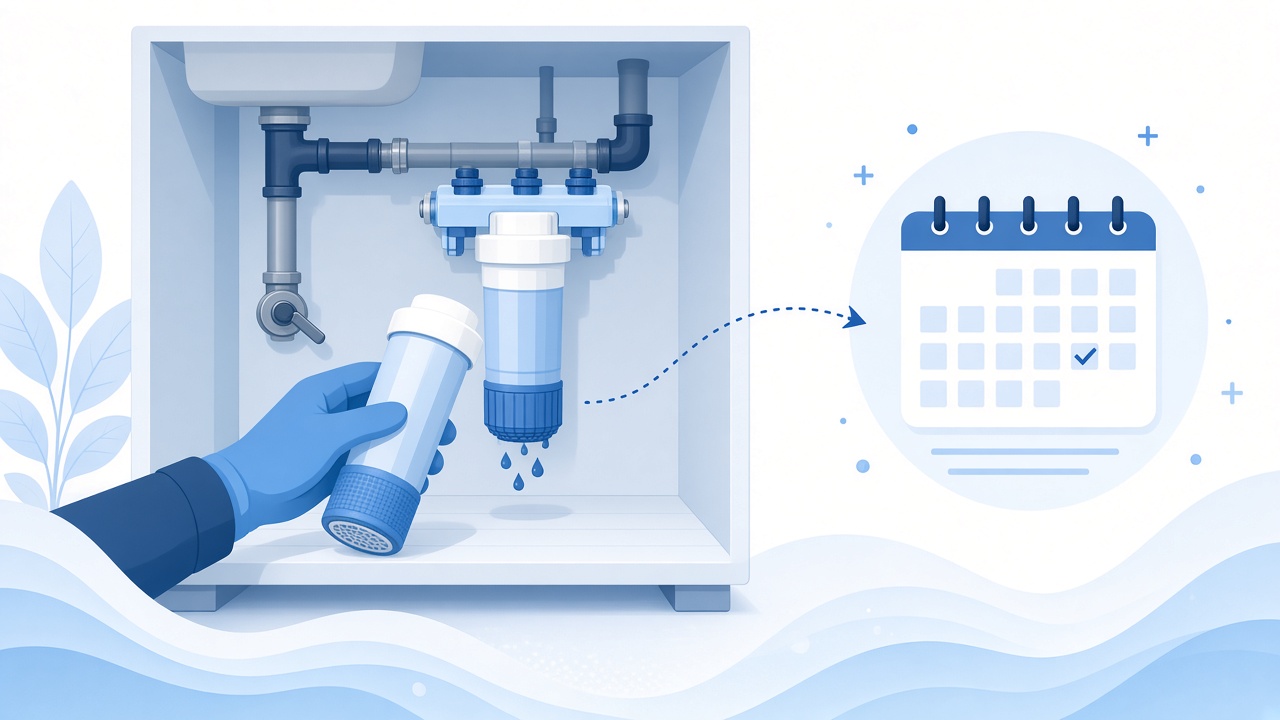
Write the installation date on each new cartridge or record it on a maintenance calendar.
Read Under-Sink Water Purifiers for more information about direct-connect, dedicated-faucet, multi-stage, and reverse-osmosis systems.
Compare replacement under-sink filters on Amazon →
Countertop Water Filters
Countertop filter life varies widely because this category includes faucet-connected filters, gravity-fed dispensers, refillable electric systems, and countertop reverse-osmosis units.
Depending on its design, a countertop cartridge might require replacement every three to twelve months. Some systems contain several cartridges that must be changed at different times.
Follow the instructions for cleaning the reservoir, dispenser, tubing, and other water-contact surfaces. Installing a new filter inside a poorly maintained unit will not correct every sanitation problem.
Compare replacement countertop filters on Amazon →
Read Countertop Water Purifiers before comparing replacement costs and maintenance requirements.
Reverse-Osmosis Filter Replacement
Reverse-osmosis systems usually contain several replaceable components:
- Sediment prefilter
- Activated-carbon prefilter
- RO membrane
- Carbon postfilter
- Additional specialty filters on some systems
Prefilters protect the RO membrane and commonly require more frequent replacement. The EPA reports that RO prefilters are often replaced around every six months, while an RO membrane may last approximately one to five years, depending on water quality and the system. These are estimates rather than instructions for every model. Read the EPA’s information about point-of-use reverse-osmosis systems.
Failing to replace prefilters may shorten membrane life or affect system performance. Some RO systems also require storage-tank sanitizing and periodic inspection of tubing, fittings, and drain connections.
Compare RO replacement-filter kits on Amazon →
Whole-House Water Filters
Whole-house systems treat water where it enters the building. Replacement schedules depend heavily on the treatment media, cartridge dimensions, household water use, sediment level, plumbing flow, and confirmed water problems.
A whole-house sediment cartridge might require replacement every three to six months, but unusually heavy sediment could clog it sooner. Larger carbon filters or media tanks may have very different service cycles.
Warning signs may include:
- Reduced water pressure throughout the house
- A visible buildup of sediment
- Returning chlorine taste or odor
- Reaching the rated gallon capacity
- Water-test results showing reduced performance
Some whole-house systems use replaceable cartridges. Others require backwashing, media replacement, chemical replenishment, professional servicing, or a combination of maintenance procedures.
Read Whole-House Water Filters for more information about point-of-entry treatment.
Compare replacement whole-house filters on Amazon →
What Can Shorten Filter Life?
A filter may need replacement sooner when the water contains more material than anticipated or the household uses unusually large amounts of water.
Factors that can reduce filter life include:
- High sediment levels
- Rust or scale from older plumbing
- Heavy household water use
- A larger number of residents
- Well-water conditions
- Construction or utility work
- Changes in municipal water treatment
- Incorrect installation
- Using a filter that is too small for the household
- Failing to maintain prefilters
A sudden drop in water flow should be investigated. Although a clogged cartridge is a common cause, plumbing problems, closed valves, mineral deposits, or other equipment issues may also reduce pressure.
Signs That a Water Filter May Need Replacement
Replace or inspect the filter when you notice:
- Slower filtration or reduced pressure
- A filter-change warning light
- Unpleasant taste or odor returning
- Cloudiness or visible particles
- Unusual noises from an RO system
- The rated gallon capacity has been reached
- The recommended replacement date has passed
- Water-testing results indicate a problem
Do not wait for visible warning signs if the recommended replacement date or capacity has already been reached.
Can You Clean and Reuse a Water-Filter Cartridge?
Most disposable household water-filter cartridges are not intended to be cleaned, refilled, or reused.
Rinsing the outside of a cartridge does not restore exhausted activated carbon or renew its certified contaminant-reduction capacity. Attempting to open, refill, or modify a cartridge could damage it and compromise the system.
Some specialty filters and whole-house systems have washable screens, cleanable components, or backwashable media. Only clean or reuse a filter when the manufacturer specifically says it is designed for that purpose.
Use the Correct Replacement Filter
Replacement cartridges that look similar are not necessarily equivalent.
Before buying, confirm:
- Manufacturer and model number
- Physical compatibility
- Applicable certification
- Specific contaminant-reduction claims
- Rated capacity
- Recommended replacement schedule
- Required flushing procedure
If you need protection from a particular contaminant, such as PFAS or lead, make sure the replacement cartridge maintains the appropriate verified claim.
Read Do Water Filters Remove PFAS? if PFAS reduction is one of your reasons for using a filter.
Keep a Water-Filter Maintenance Record
A simple maintenance record can prevent missed replacements.
Record:
- System manufacturer and model
- Cartridge model number
- Installation date
- Recommended replacement date
- Rated gallon capacity
- Cartridge cost
- Cleaning and sanitizing dates
- Water-test results
- Notes about flow, pressure, taste, or odor
You can also set a reminder on your phone or calendar several days before the expected replacement date.
Consider purchasing a spare cartridge in advance so the correct replacement is available when needed.
Compare Replacement Water Filters
Before purchasing a filtration system, calculate its continuing maintenance costs. A lower-priced system may cost more over time if its cartridges are expensive or require frequent replacement.
Compare replacement water filters on Amazon →
Before ordering replacement cartridges, verify the exact system and filter model number to avoid an incompatible purchase.
Final Thoughts
How often you should replace a water filter depends on the exact system, rated capacity, water conditions, and household use.
The manufacturer’s schedule should take priority over general online estimates. Replace the cartridge when it reaches its time limit or rated gallon capacity, whichever occurs first.
Keep a maintenance record, use the correct replacement cartridge, and follow all cleaning, sanitizing, and flushing instructions. When reducing a health-related contaminant is important, periodic water testing can provide additional information about whether the treatment system is performing as intended.
Water conditions and filtration systems vary. This educational article does not replace water testing, manufacturer instructions, local health guidance, or advice from qualified water-treatment and plumbing professionals.