Whole House Water Filters: A Beginner’s Guide
A whole-house water filtration system treats water before it reaches the faucets, showers, appliances, and other fixtures throughout your home. It can improve water quality, but the right system depends on what is in your water and how much water your household uses.
Affiliate Disclosure: This page contains affiliate links. If you purchase through these links, I may earn a small commission at no extra cost to you. As an Amazon Associate, I earn from qualifying purchases. This helps support Water Purifiers World and allows me to keep providing free guides to cleaner, safer water for homes and businesses. I only recommend products I personally believe in and would use myself. Thank you for your support! Read our full affiliate disclosure.
Start by Testing Your Water
Before buying a whole-house filter, find out what is actually in your water.
If you receive municipal water, review your water company’s annual Consumer Confidence Report. If you use a private well, consider having the water tested by a qualified laboratory. Well owners should also read our guide to well water filtration systems.
Testing is important because one filter cannot solve every water problem. For example, activated carbon may reduce chlorine taste and odor, but it may not remove hardness, bacteria, iron, nitrates, or other contaminants.
What Do Whole-House Filters Remove?
The answer depends on the filtration stages included in the system.
- Sediment filters capture sand, rust, dirt, and other particles.
- Activated-carbon filters can reduce chlorine and improve unpleasant tastes and odors.
- Specialized filters may address iron, manganese, or sulfur odors.
- Water softeners reduce hardness minerals but are not the same as general water filters.
- UV systems may help control certain microorganisms, but they do not remove chemicals, sediment, or hardness.
Always match the equipment to your water-test results.
City Water vs. Well Water
Your water source changes which whole-house setup makes sense.
City (municipal) water
- Chlorine: Standard activated carbon handles chlorine taste and odor well.
- Chloramine: Many utilities now use chloramine instead of chlorine. Ordinary carbon is less effective against it. Look for catalytic carbon or a system with a specific chloramine claim. Your utility’s water-quality report says which disinfectant it uses.
- Sediment: A sediment prefilter protects the carbon stage and your fixtures.
Private well water
- Iron, manganese, and sulfur: These usually need specialized media or oxidizing systems sized to your lab results.
- Bacteria: A UV system can inactivate many microorganisms, but only when the water is clear. It needs sediment prefiltration, and iron or hardness can coat the lamp sleeve. Look for NSF/ANSI 55 certification.
- Hardness: A water softener addresses hardness minerals. It is not a filter for other contaminants.
Cartridge Systems vs. Tank Systems
| Cartridge housings | Tank (media) systems | |
|---|---|---|
| How it works | Replaceable cartridges in one to three housings | A large tank of filter media, sometimes with backwashing |
| Upfront cost | Lower | Higher |
| Maintenance | Frequent cartridge swaps, often every few months | Less frequent, but media replacement is a bigger job |
| Flow capacity | Depends on cartridge size; 4.5″ × 20″ “big blue” housings flow far better than 10″ standard ones | Generally designed for whole-home flow |
| Good fit for | Sediment and chlorine on city water; budget-conscious homes | Larger homes, long service life, or specific well-water problems |
Check the Certification Claims
Do not assume that a filter removes every contaminant simply because it displays an NSF certification mark.
NSF/ANSI 42 commonly applies to specific aesthetic improvements, such as reducing chlorine taste and odor. NSF/ANSI 53 applies to certain contaminants that may affect health.
Check the exact model to learn which contaminants it is certified to reduce.
Choose the Correct Size
A whole-house system must handle the amount of water used when several fixtures are operating at the same time.
When comparing systems, consider:
- Rated service flow in gallons per minute
- Number of bathrooms and household members
- Plumbing size and water pressure
- Filter capacity
- Expected pressure loss
- Replacement-filter schedule
A system that is too small may cause poor water pressure when showers, faucets, and appliances are used together.
Estimate your peak flow
Think about the most water your home uses at one moment: two showers running while the dishwasher fills, for example. Add the flow of each fixture that runs at the same time. Federal limits cap new showerheads at 2.5 gallons per minute and kitchen faucets at 2.2, so two showers plus a kitchen faucet can approach 7 gallons per minute. Choose a system whose rated service flow exceeds your peak, and match its connection size (commonly 3/4″ or 1″) to your main line so it doesn’t become a bottleneck.
Consider Installation and Maintenance
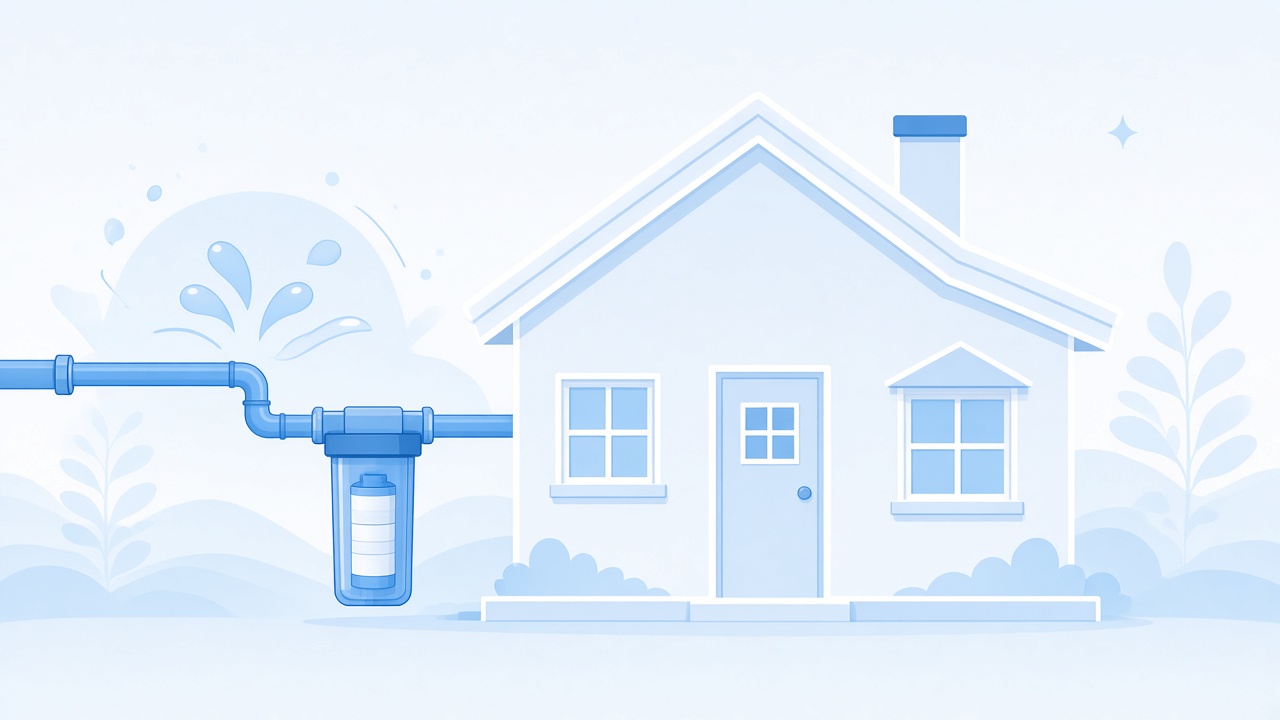
Whole-house filters are normally installed where the main water line enters the home. Leave enough space for filter changes, tanks, bypass valves, and future repairs.
Some systems may also require electricity or a drain connection. Professional installation may be worthwhile if the system requires major plumbing changes.
Remember to include the long-term costs of replacement cartridges, media, water testing, maintenance, and service—not just the original purchase price.
Installation checklist
- Bypass valves: Install shutoff and bypass valves so you can change filters without cutting water to the house.
- Electrical grounding: In some homes, metal water pipes are part of the electrical grounding system. Cutting into the line can break that path, so a bonding (jumper) wire across the filter may be required. Ask a licensed plumber or electrician if you’re unsure.
- Local codes: Some areas require permits or a licensed plumber for main-line work.
- Location: Install indoors or in a protected spot where the system can’t freeze, with room to lift housings off for cartridge changes.
- Water heater: The filter should come before the water heater so both hot and cold lines are treated.
Compare Whole-House Water Filters
Whole-House Systems Worth Comparing
Match the system to your tested problem, plumbing size, and peak flow.
| Model | Type | Good fit for | Check before buying | |
|---|---|---|---|---|
| iSpring WGB32B | 3-stage sediment + carbon | Sediment and chlorine taste or odor on city water | Plumbing connection size and replacement-cartridge schedule | Check price → |
| iSpring WGB32BM | 3-stage with iron/manganese stage | Well water with confirmed iron or manganese staining | Your actual iron and manganese levels from a lab test | Check price → |
| Aquasana WH-1000 | Carbon + KDF, long-life tank | Low-maintenance chlorine reduction for larger homes | Installation space and professional-install cost | Check price → |
Certifications differ between versions of the same model. Confirm the exact model number in the NSF certified-products database before buying. As an Amazon Associate, we earn from qualifying purchases.
Before buying, compare each system’s flow rate, filter capacity, plumbing connection size, replacement costs, warranty, and specific contaminant-reduction claims.
Compare whole-house water filtration systems on Amazon →
For a side-by-side decision, read our reverse osmosis vs. whole-house filtration comparison.
Do You Still Need a Drinking-Water Filter?
Often, yes. A whole-house system is usually sized for sediment, chlorine, and household-wide problems. It is generally not the right tool for lead. Lead typically comes from service lines, household plumbing, solder, or fixtures, and much of that sits after the point where the whole-house filter is installed.
For lead, PFAS, or other health-related contaminants in drinking and cooking water, pair your whole-house system with a certified point-of-use filter. See our guides to under-sink water purifiers and PFAS filters, or compare both approaches in reverse osmosis vs. whole-house filtration.
Common Questions
Will a whole-house filter lower my water pressure?
Some pressure loss is normal, and it grows as cartridges clog. A properly sized system with the right connection size keeps the drop small. A sudden drop usually means it’s time to change the sediment cartridge.
How long do whole-house cartridges last?
Sediment cartridges often last 3 to 6 months and carbon cartridges 6 to 12 months, but heavy sediment or high water use shortens that. See how often to replace water filters.
Can I install one myself?
Many handy homeowners install cartridge systems, but it means cutting into the main line. Check local codes and the grounding issue above, and hire a licensed plumber if you’re unsure.
Is a water softener a whole-house filter?
No. See Water Softener vs. Water Filter to understand the difference. A softener reduces hardness minerals like calcium and magnesium. It doesn’t address chlorine, sediment, or most other contaminants.
Final Thoughts
A whole-house water filtration system can provide cleaner water throughout your home, but it should be selected according to your actual water conditions.
Start with water testing, identify the problems you need to correct, and then compare filtration methods, flow rates, certifications, installation requirements, and long-term costs. This will help you avoid purchasing a system that is unnecessary, undersized, or unsuitable for your water.
Water conditions vary. This article provides general educational information and does not replace professional water testing or advice from qualified water-treatment and plumbing professionals.