By Rick | Reviewed/updated: October 2026
Affiliate Disclosure: This page contains affiliate links. If you purchase through these links, I may earn a small commission at no extra cost to you. As an Amazon Associate, I earn from qualifying purchases. This helps support Water Purifiers World and allows me to keep providing free guides to cleaner, safer water for homes and businesses. I only recommend products I personally believe in and would use myself. Thank you for your support! Read our full affiliate disclosure.
Fluoride is back in the headlines in 2026. Two states have banned it from public water, supply shortages have forced some cities to cut back, and more people are asking a simple question: does my water filter remove fluoride? Most people assume theirs does. Most are wrong. This guide explains which filter types actually remove fluoride, which ones don’t, and how to check the exact model you are considering.
Quick Answer: Do Water Filters Remove Fluoride?
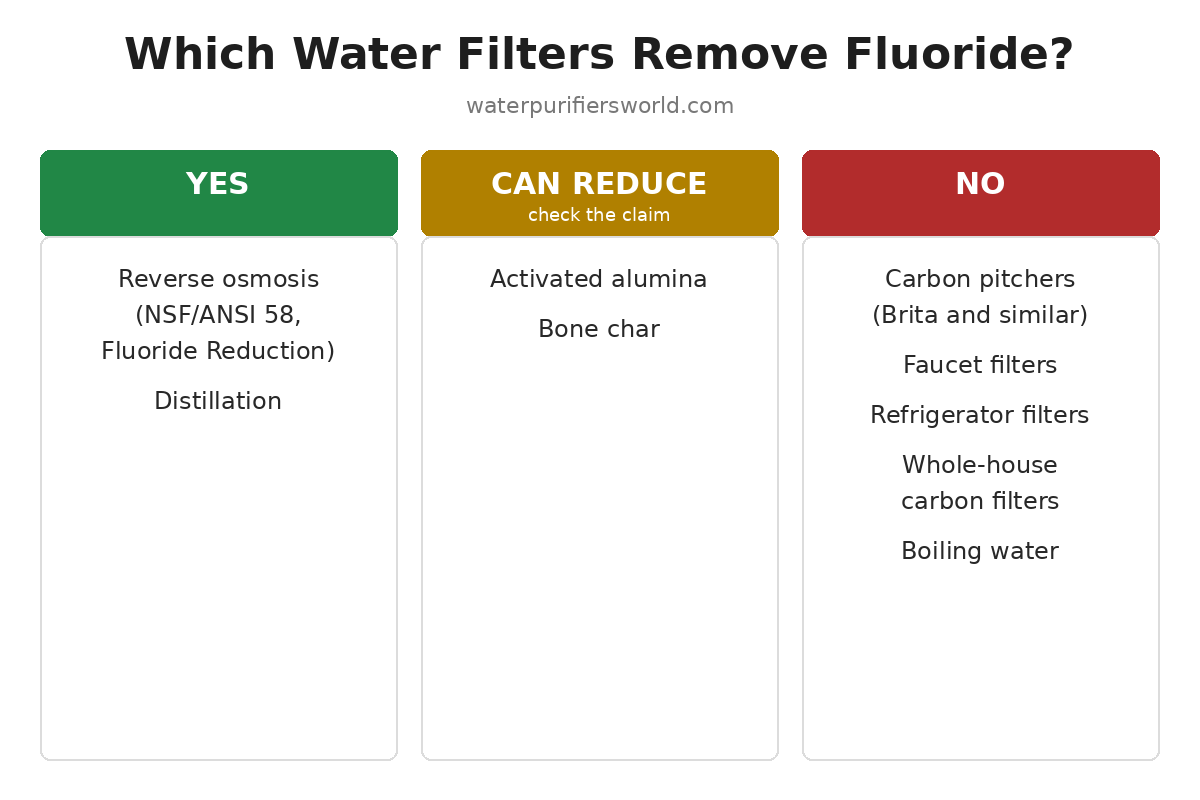
Most standard water filters do not remove fluoride. Activated-carbon pitchers, faucet filters, and refrigerator filters let it pass through, and boiling does not remove it. Reverse osmosis and distillation do. Activated alumina and bone char can also reduce fluoride. For proof, choose a reverse-osmosis system certified to NSF/ANSI 58 for fluoride reduction.
Why People Are Asking About Fluoride in 2026
Utah became the first state to ban adding fluoride to public drinking water in March 2025, with the law taking effect May 7, 2025. Florida followed on May 15, 2025, with its ban effective July 1, 2025. No other state passed a ban in 2026, though bills were filed in 23 states.
At the same time, a supply shortage of the fluoridation chemical hydrofluorosilicic acid has disrupted systems nationwide. Baltimore temporarily lowered its fluoride level from about 0.7 mg/L to 0.4 mg/L starting the week of April 14, 2026, and NPR reported the shortage nationally. Davie County, North Carolina stopped fluoridating on September 1, 2026, and the same NC Health News report notes Milwaukee halved its fluoride level while several Louisiana cities paused.
Meanwhile the EPA is running a fast-tracked review of fluoride’s health risks and released its protocol on August 3, 2026. The enforceable federal limit is still 4.0 mg/L, set in 1986 and last reviewed in 2024. The CDC still recommends 0.7 mg/L for preventing cavities. A 2024 National Toxicology Program review found, with moderate confidence, that fluoride above 1.5 mg/L is linked to lower IQ in children, and found the data insufficient to say whether 0.7 mg/L has an effect.
Find Out How Much Fluoride Is in Your Water First
If you are on city water, ask your utility or read its annual water quality report, called a Consumer Confidence Report. The CDC says your local water provider is the best source for your fluoride level. If you have a private well, fluoride can only be measured by a lab test, and your local health department can point you to a lab.
Three numbers matter:
| Level | What it is |
|---|---|
| 0.7 mg/L | CDC and U.S. Public Health Service recommended level for cavity prevention (advisory, not a limit) |
| 2.0 mg/L | EPA secondary level, aimed at preventing dental fluorosis in children; systems above it must notify customers |
| 4.0 mg/L | EPA enforceable maximum contaminant level |
The CDC says that if your water is at 4.0 mg/L or higher, contact your health department and consider a filter that removes fluoride for your drinking and cooking water. Before buying anything, read How to Test Your Water Before Buying a Filter.
Which Water Filters Remove Fluoride?
Fluoride is a dissolved mineral ion, so it takes a membrane, distillation, or special media to remove it. Ordinary carbon does not do it.
Reverse Osmosis (Under-Sink and Countertop)
The CDC says reverse osmosis “may also reduce” fluoride, so check the label for the specific claim. NSF/ANSI 58, the standard for reverse osmosis systems, has an optional Fluoride Reduction claim, and NSF’s consumer claims guide lists only reverse osmosis systems under fluoride.
Here is how the certified test works: the system is challenged with 8.0 mg/L fluoride and must deliver 1.5 mg/L or less. Real performance data sheets show what that looks like in practice. The 3M RO501 averaged 97.4% fluoride reduction with 0.23 mg/L product water, and the A.O. Smith RO 4000 averaged 81.2% reduction. Those are examples from specific models, not a general claim about all RO systems.
Trade-offs are real: RO wastes some water, removes minerals along with contaminants, and needs regular filter and membrane changes. See our guides to under-sink water purifiers and countertop water purifiers.
One model to look at: the iSpring RCC7AK under-sink RO (check price on Amazon). One caution before you buy: NSF lists different variants of this model with different certified claims, so compare under-sink RO systems certified to NSF/ANSI 58 and check the exact model’s listing for Fluoride Reduction, as explained in the certification section below. Renters may prefer a countertop unit. DREO says its countertop RO filter reduces fluoride and is SGS-tested to NSF/ANSI 58 (check price on Amazon). Treat that as a manufacturer claim: DREO did not appear in NSF’s own NSF/ANSI 58 listings.
Distillation
The EPA says distillation and reverse osmosis “have proven to be effective for removing fluoride to below 4.0 mg/L.” Distillers fall under NSF/ANSI 62. They are slow and use more energy than other methods, and Virginia Cooperative Extension notes that distilled water tastes “flat.” We link to no distiller on this site.
Activated Alumina
Virginia Cooperative Extension describes activated alumina as a packed bed of granules that pulls fluoride out of the water. It works in water with pH below 8.5, needs sediment pre-filtering if sediment is present, can get “used up” faster when other contaminants are present, and needs cartridge replacement plus monitoring of the treated water.
The World Health Organization notes that point-of-use activated alumina can remove fluoride from small volumes of water, though international performance standards for it had not been developed at the time of its 2006 review. If you go this route, check the cartridge’s rated capacity and replace it on schedule.
Bone Char
The WHO explains that bone char takes up fluoride through its calcium-phosphate (hydroxyapatite) structure. Quality depends heavily on how it is made, and poorly made bone char can give water a bad taste and smell. Bone char filters are rarely backed by a fluoride certification, so treat any brand’s fluoride numbers as manufacturer claims.
Anion Exchange
Virginia Cooperative Extension notes that anion-exchange resin can take up fluoride, but other anions compete with it and the resin needs brine regeneration.
Which Filters Don’t Remove Fluoride?
Brita and other standard carbon pitchers. Brita US says its filters “keep a healthy level of fluoride.” Brita’s UK and Australia FAQ states plainly: “BRITA water filters are not designed to remove fluoride.” PUR’s pitcher performance data sheet does not list fluoride among its certified reductions. For a full side-by-side look at what each pitcher is certified to reduce, see our comparison of the best water filter pitchers. See also our best water filtration systems for home.
Faucet-mount and refrigerator filters. The EPA says “typical charcoal-based” home filters don’t remove fluoride, and NSF’s claims guide lists fluoride only under reverse osmosis systems.
Whole-house carbon filters. Same carbon limitation. The CDC adds that fluoride is not absorbed through skin, so bathing and cleaning with fluoridated water is fine. Most people only need to treat drinking and cooking water. Related: whole-house water filters and reverse osmosis vs. whole-house filtration.
Boiling. The EPA is direct: “Boiling water does not remove fluoride.”
Water softeners. For more on what softeners do, see Water Softener vs. Water Filter. We won’t say they do or don’t. The CDC says “some may also remove fluoride,” so check the label on your specific unit.
ZeroWater and Clearly Filtered (special case). These brands advertise fluoride reduction based on lab tests they paid for, which is not the same as a certified fluoride claim. ZeroWater’s FAQ claims 99% fluoride reduction “tested by an EPA certified lab,” and Clearly Filtered publishes IAPMO lab results while its pitcher is NSF-certified only to standards 42 and 372. Call these manufacturer claims and run them through the certification check below.
Check the Exact Certification
Mirror this logic every time you shop: look for “NSF/ANSI 58, Fluoride Reduction” on the specific model’s listing, not just an “NSF” logo on the box. Search NSF’s listings for the exact model, or the listings from other accredited certifiers such as IAPMO or WQA, and confirm “Fluoride Reduction” actually appears.
Learn the difference between “tested to” NSF/ANSI 58 and “certified to” NSF/ANSI 58 for fluoride. Brands like DREO say “Certified by SGS with NSF/ANSI 58 standards.” Confirm the claim in a certifier’s public listing before you trust it.
Here is a real example of why the exact model matters. NSF lists the iSpring RCC7AK made at its Taiwan facility for TDS Reduction only. The RCC7AK-BLK and RCC7AK-BN made at its Nanjing facility are listed with Fluoride Reduction. Same family name, different certified claims. This is the same certification logic we use in Do Water Filters Remove PFAS?
Replace Filters and Membranes on Schedule
Activated alumina capacity gets used up, and RO pre-filters and membranes need replacing on the manufacturer’s schedule. A system with an exhausted cartridge is just an expensive decoration. See how often to replace water filters.
Should You Remove Fluoride?
The CDC notes that filters remove both good and bad substances, including fluoride, which helps prevent cavities. If your water falls below 0.7 mg/L, the CDC suggests talking to a dentist or pediatrician. For infant formula, the CDC says formula mixed with fluoridated water may raise the chance of mild dental fluorosis, and that bottled water labeled deionized, purified, demineralized, or distilled contains no or only trace fluoride. This site doesn’t tell you whether to remove fluoride. Talk with your dentist or doctor about what’s right for your family.
Frequently Asked Questions
Does Brita remove fluoride?
No. Brita says its filters keep fluoride in fluoridated tap water and are not designed to remove it.
Does reverse osmosis remove fluoride?
Reverse osmosis can reduce fluoride. Look for a system certified to NSF/ANSI 58 for fluoride reduction, which is tested to bring 8.0 mg/L down to 1.5 mg/L or less.
Does boiling water remove fluoride?
No. The EPA says boiling water does not remove fluoride.
Do refrigerator filters remove fluoride?
Standard refrigerator filters use carbon, which does not remove fluoride. NSF lists fluoride certification only for reverse osmosis systems.
Do I need a whole-house fluoride filter?
Usually not. The CDC says fluoride isn’t absorbed through skin, so most people only need to treat drinking and cooking water.
Is distilled or purified bottled water fluoride-free?
The CDC says bottled water labeled deionized, purified, demineralized, or distilled contains no or only trace fluoride unless fluoride is listed as an added ingredient.
How do I find out how much fluoride is in my water?
Ask your water utility or read its annual water quality report. Private well water needs a lab test.
Final Thoughts
Find your fluoride level first. If you want fluoride out of your drinking water, look for a reverse osmosis system certified to NSF/ANSI 58 for fluoride reduction. Treat every other claim as a claim until you see it in a certifier’s listing.
Trusted Sources and Further Reading
EPA, Questions and Answers on Fluoride
EPA, Fluoride in Drinking Water
CDC, About Home Water Treatment Systems
CDC, Community Water Fluoridation FAQ
NSF, Contaminant Reduction Claims Guide
NSF, NSF/ANSI 58 Reverse Osmosis standard overview
Virginia Cooperative Extension, Fluoride in Household Water
WHO, Fluoride in Drinking-water (2006)
NTP, Fluoride Exposure: Neurodevelopment and Cognition (2024)