By Rick | Reviewed/updated: October 2026
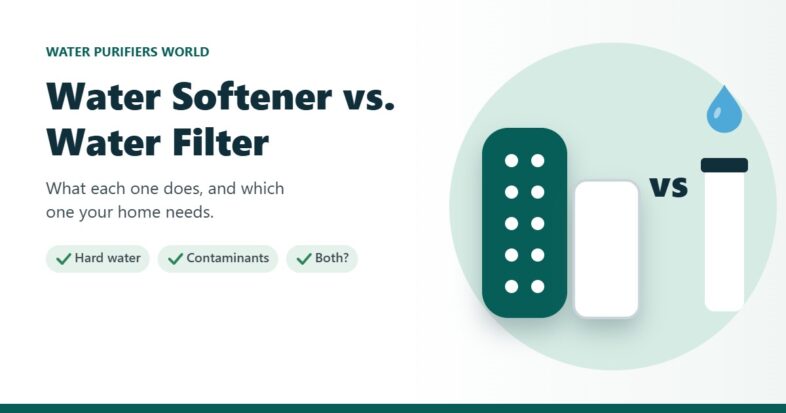
Water softeners and water filters are often sold side by side, and many people assume they do the same job. They do not. A softener deals with hard water minerals. A filter reduces contaminants such as chlorine, lead, or sediment. Many homes need one or the other, and some need both. This guide explains the difference so you can buy the right equipment.
Affiliate Disclosure: This page contains affiliate links. If you purchase through these links, I may earn a small commission at no extra cost to you. As an Amazon Associate, I earn from qualifying purchases. This helps support Water Purifiers World and allows me to keep providing free guides to cleaner, safer water for homes and businesses. I only recommend products I personally believe in and would use myself. Thank you for your support! Read our full affiliate disclosure.
Quick Answer
A water softener removes hardness minerals, mainly calcium and magnesium, using a process called ion exchange. It prevents scale and soap scum but does not purify water. A water filter reduces specific contaminants, depending on its design, such as chlorine taste and odor, sediment, lead, or PFAS. If you have scale problems, you need a softener. If you have contaminant concerns, you need a filter certified for those contaminants. Test your water to find out which problems you have.
Softener vs. Filter at a Glance
| Water softener | Water filter | |
|---|---|---|
| Main job | Removes hardness minerals | Reduces specific contaminants |
| How it works | Ion exchange, usually with salt | Carbon, sediment media, membranes, or other media |
| Fixes | Scale, spotty dishes, soap that will not lather | Taste, odor, sediment, and certified health contaminants |
| Does not fix | Bacteria, lead, chlorine, PFAS on its own | Hardness, in most cases |
| Maintenance | Add salt, occasional cleaning | Replace cartridges on schedule |
| Certification to look for | NSF/ANSI 44 | NSF/ANSI 42, 53, 58, or 401, depending on the claim |
What Is Hard Water?
Hard water contains dissolved calcium and magnesium. It is not considered a health risk, but it causes problems around the house:
- White scale on faucets, showerheads, and kettles
- Spots on dishes and glassware
- Soap and shampoo that do not lather well
- Scale buildup that can shorten the life of water heaters and appliances
- Dry-feeling skin and hair for some people
Hardness is measured in grains per gallon (gpg) or milligrams per liter (mg/L). The U.S. Geological Survey classifies water above about 120 mg/L, or roughly 7 gpg, as hard, and above 180 mg/L as very hard. A simple water hardness test strip gives a quick reading, and your water utility’s annual report often lists hardness too.
How a Water Softener Works
Most softeners pass water through a tank of resin beads that trade sodium (or potassium) for calcium and magnesium. When the beads are full, the system regenerates by flushing them with salty water from a brine tank.
- Choose a softener sized for your hardness level and household water use
- Keep the brine tank stocked with softener salt
- If you need to limit sodium, ask your doctor, and consider potassium chloride instead of sodium salt, or keep an unsoftened tap for drinking
- Softeners send salty water down the drain during regeneration. Some communities restrict them, so check local rules
What About Salt-Free Softeners?
“Salt-free” systems, often called conditioners, do not remove hardness minerals. Many change the minerals so they are less likely to form scale. They can reduce scale for some homes, but they will not give you truly soft water, and results vary. Be skeptical of strong claims, and look for independent test data.
How a Water Filter Works
Filters use different technologies for different jobs:
- Sediment filters catch sand, rust, and particles
- Activated carbon reduces chlorine taste and odor and, in certified models, some chemicals and metals such as lead
- Reverse osmosis reduces many dissolved substances, including fluoride and nitrate, at a single faucet
- Specialty media target iron, sulfur, arsenic, or other specific problems
Learn the basics in Water Filters and Water Filtration: A Beginner’s Guide.
When You Need Both
Many homes with hard water also want better drinking water. A common setup is a whole-house softener plus a drinking-water filter at the kitchen sink. Softening before a reverse-osmosis system can also help the RO membrane last longer.
- Hard water plus chlorine taste: softener plus a carbon whole-house filter or a kitchen filter
- Hard well water with iron: see our guide to well water filtration systems
- Hard water plus concerns about lead or PFAS: softener plus a certified under-sink filter or RO system
Questions to Ask Before Buying
- What did my water test show for hardness and contaminants?
- Is the softener certified to NSF/ANSI 44, and sized for my hardness and household?
- Is the filter certified for the specific contaminants I want to reduce?
- Where will it be installed, and do I need a drain and an electrical outlet?
- What will salt, cartridges, and maintenance cost each year?
Frequently Asked Questions
Does a water softener purify water?
No. A softener removes hardness minerals. It is not designed to remove bacteria, lead, chlorine, or PFAS.
Can I drink softened water?
Most healthy people can, but softened water contains added sodium. People on sodium-restricted diets should ask their doctor, and many homes keep one unsoftened tap for drinking and cooking.
Does a filter remove hardness?
Most standard filters do not. Reverse osmosis reduces hardness minerals at one faucet, but it is not a practical way to soften a whole house.
Final Thoughts
Softeners fix hardness. Filters fix contaminants. Test your water, identify which problems you actually have, and choose equipment certified for those specific problems.
Water conditions vary. This educational article does not replace laboratory testing, local health guidance, or advice from qualified water-treatment and plumbing professionals.